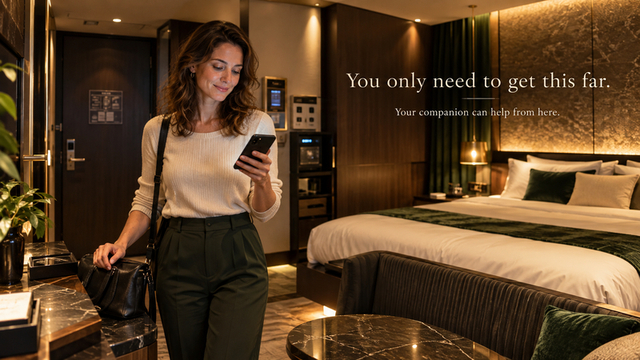
You are coming to Tokyo. You find someone at OPUS who makes you pause and think, “I’d like to meet him.” Then another question appears:
Where is reception? Do I need a reservation? What does “REST” mean? When do I pay? Will my foreign credit card work? What if the machine is only in Japanese?
Often, the uncomfortable part is not the hotel itself. It is simply: “I don’t know what happens next.”
You only need to get this far: meet your companion. From there, you are not figuring everything out alone.
A Japanese love hotel may begin differently from the hotels you know
In many hotels overseas, the sequence is familiar: enter the lobby, find reception, give your name, check in and receive a room key. Some Japanese love hotels work differently.
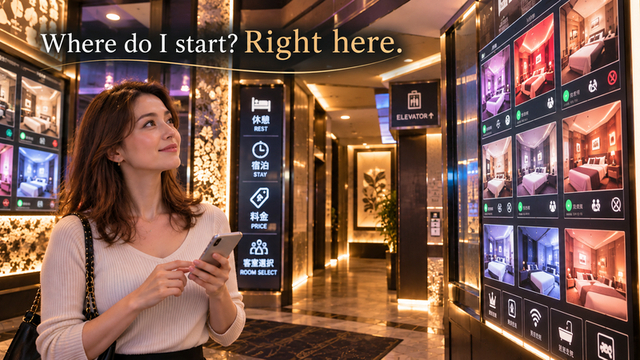
Near the entrance, you may find a large panel displaying photographs of available rooms. You look at the rooms, see what is available, and choose the one you like.
Sometimes, the answer is simply: right here.
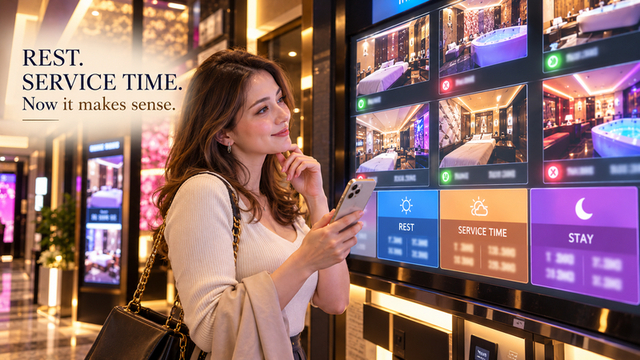
“REST” does not simply mean taking a rest
In a Japanese love hotel, REST is commonly used as a short-stay pricing category. The exact time depends on the hotel, but it is often around two or three hours. SERVICE TIME usually refers to a longer stay within specified hours and conditions, while STAY generally means overnight use.
Payment may happen at a different moment than you expect
Payment systems vary from one Japanese love hotel to another. You may pay when entering, when leaving, at the front desk, or through a machine inside the room.
We have seen how a tiny difference in expectations can create confusion. A visitor from Europe once tried to pay shortly after entering a Japanese love hotel. The hotel staff understood the situation differently and began asking questions in Japanese.
Nothing dramatic had happened. Each side simply expected a different next step.
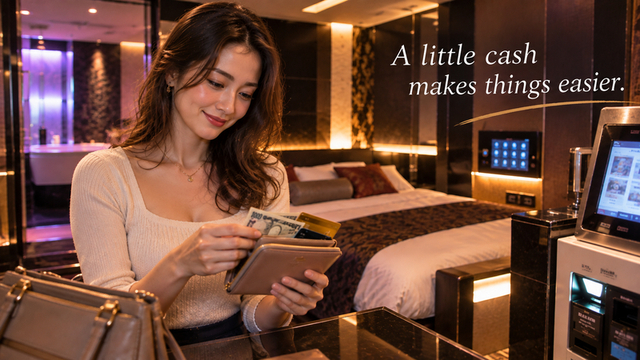
Carry a little Japanese cash as well as your card
Many places in Tokyo accept credit cards, and some love hotels do too. Still, seeing a Visa or Mastercard logo does not necessarily mean that every overseas-issued card will work in every hotel. Payment systems and card acceptance vary.
Meet your companion. From here, you are not figuring it out alone.
Tokyo. An unfamiliar neighborhood. Your first Japanese love hotel. A control panel written in Japanese. A person you are meeting for the first time. Put them all together, and they can suddenly feel much bigger.
Enter the room.
Message your companion.
Meet him.
That is far enough. Once you meet your OPUS companion, if you do not understand a machine, a payment screen, a hotel instruction or what to do when leaving, ask him. You can look at it together.
From here, you’re not figuring it out alone.

You can choose the person first, and work out the hotel afterwards
Tokyo has many possible places to stay. If one room is unavailable, another may be available. If a love hotel still feels unfamiliar, you can also consider a more familiar type of hotel after checking its guest and visitor policies.
There are usually different possibilities for the place.
But when you look at one particular companion and think, “I want to meet him,” his availability during the dates you are actually in Tokyo is different. Another room can be another room. Another person is not the same person.
Check your dates and his availability.
Then work out a comfortable place.

What you remember from Tokyo may not be the room number
You may remember the first moment you met. The conversation that made you relax. The moment you both laughed. The few hours in Tokyo that you chose simply because you wanted them for yourself.
The hotel matters. But it is the setting, not the person at the centre of the memory.