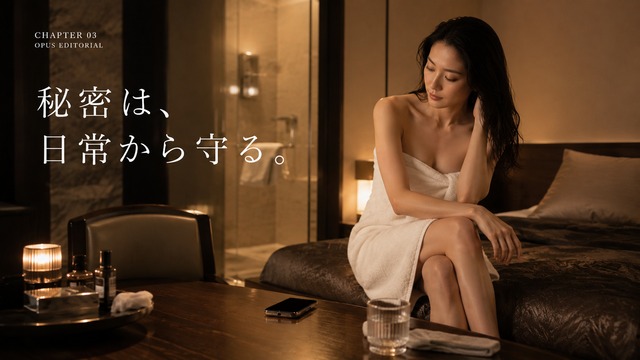
Are Women-Oriented Adult Services Really Dangerous?|A Five-Chapter Series
CHAPTER 03 / 05
Where Do Privacy Leaks
and Unwanted Disclosure Begin?
The next points to consider are unwanted disclosure and privacy.
Some women considering the use of women-oriented adult services may be more concerned about someone finding out than about the service itself.
To prevent unwanted disclosure, you first need to consider separately who might find out and what could lead them to discover it.
1. Unwanted Disclosure in Everyday Life
Common triggers in everyday life include the following:
・Someone sees your smartphone notifications or history
・You leave a LINE or other chat screen open
・Your browser history remains visible
・Someone sees a receipt in your wallet or bag
・You tell an acquaintance about using the service, and they pass it on to someone else
・You use a shared device or shared account
In other words, information often leaks not through sophisticated technology or a major incident, but through small lapses in everyday privacy management.
Locking your phone, hiding notification content from the screen, clearing your history, avoiding carrying paper records and not telling others can prevent many cases.
2. Credit Card Statements
For credit card payments, many adult service providers use payment processing companies. A payment processing company is a specialist company that handles payments on behalf of a business.
The customer pays through the payment processing company, and the business subsequently receives the payment from that company. Therefore, as long as a payment processing company is involved, the customer’s card details are not passed directly to the adult service provider.
the adult service provider’s name will not appear as-is on your card statement.
Likewise, the adult service provider’s name will not appear as-is on your card statement. Instead, it will show the payment processing company’s name or a name designated for payment purposes. There is no need to be overly concerned about the adult service provider’s name appearing on the statement.
3. The Possibility of Being Seen Entering or Leaving a Hotel
It is impossible to eliminate entirely the possibility of unexpectedly encountering someone you know in the city. However, even in everyday life, you are unlikely to run into an acquaintance you had no plans to meet during your days off or outside working hours.
In a busy city such as Tokyo, you can further reduce the likelihood of being seen by avoiding areas near your home or workplace, choosing a neighbourhood you do not normally visit, meeting inside the hotel, and carefully planning your arrival and departure times and travel route.
4. Personal Information You Provide to the Service Provider
Adult service providers are businesses, and they have nothing to gain from disclosing customer information without good reason. Even so, you do not need to provide every piece of information without considering whether it is necessary.
You can also protect your privacy by checking what information is required when making a booking, whether you need to provide your real name, whether a privacy policy is published, and whether you can stop communications after using the service, so that you do not provide more information than necessary.
What matters is avoiding preventable risks, understanding what you can manage yourself, and then choosing the experience you want.
- 01|Breaking Down the Sense of Danger into Three Areas
- 02|How Should You Think About Physical Risks?
- 03|Where Do Privacy Leaks and Unwanted Disclosure Begin? (Currently Viewing)
- 04|The Often-Overlooked Risk of Dissatisfaction
- 05|Feeling Safe Means Being Able to Check, Decline and Choose for Yourself
![[Five-Part Series | Chapter 5] Your Peace of Mind Continues Until You’re on Your Way Home](https://opus-tokyo.jp/wp-content/uploads/2026/08/safe-goodbye-en.jpg)