Tag: Female Psychology

  • 04 | What Adult Services Sell Is More Than Sex | OPUS

    04 | What Adult Services Sell Is More Than Sex | OPUS

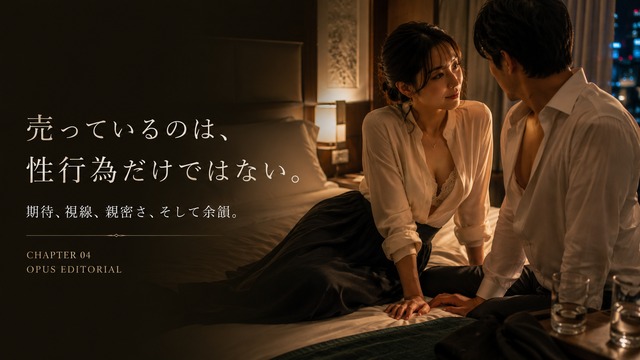
    OPUS COLUMN 04

    What Adult Services Sell
    Is More Than Sex

    Unlike real-life romance, adult services offer ease and clarity. There is no need to make endless efforts to win someone’s affection, nor do you have to take responsibility for their life or future. Precisely because the exchange is clearly defined, you can safely let go of your emotions without taking on responsibility.

    What adult services provide is not simply a sexual act. It is the anticipation and racing heartbeat before you meet, the gaze directed at you alone, the exhilaration of being treated with care as a woman, and the pleasant afterglow that remains once you part. It is the value of a complete experience encompassing all of these moments.

    Even within a clearly defined form of simulated romance, the memory of being cherished and the sense of emotional fulfilment it creates are genuine. Here, there is a special kind of time in which you can set your heart free within a safe framework.

    A thoughtful experience that sets your heart free.

    Visit the OPUS Home Page
    \n\n
  • 05 | You Don’t Need to Hold Back from Being a Woman | OPUS

    05 | You Don’t Need to Hold Back from Being a Woman | OPUS

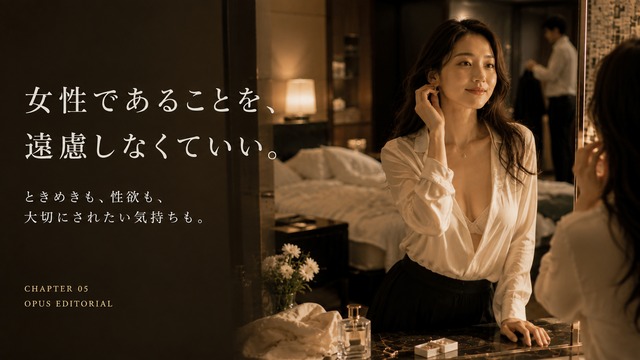
    OPUS COLUMN 05

    You Don’t Need to Hold Back
    from Being a Woman

    As we make our way in the world, our days become filled with many different roles: professional, mother, wife, daughter, and the person who looks after everyone around her. Amid it all, there are times when we may almost forget what it feels like to be excited and inspired simply as a woman.

    To want to be cherished, desired, held, and thrilled once again—these are beautiful, precious feelings that arise naturally within a woman. There is no need to feel ashamed of them or to hide them.

    You don’t need to hold back from being a woman. You don’t need to apologise for having desires. OPUS is a place where you can laugh and feel desired as a woman, set your heart free, and step forward again tomorrow as your true self.

    Take time to rediscover your own unique radiance.

    Go to the OPUS Homepage
    \n\n
  • 03 | Women-Focused Adult Services Are a Place to Express Desire | OPUS

    03 | Women-Focused Adult Services Are a Place to Express Desire | OPUS

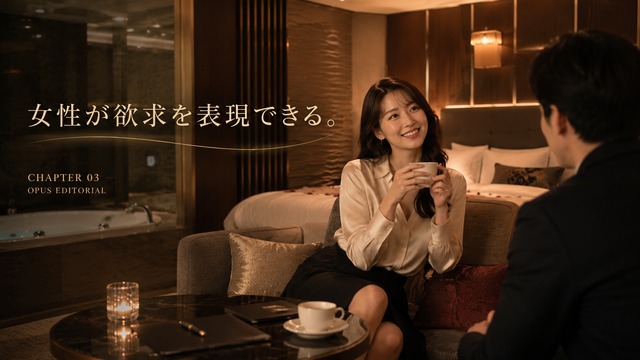
    OPUS COLUMN 03

    Women-Focused Adult Services Are
    a Place Where Women Can Express Their Desires

    In women-focused adult services, companions need more than technical skill or physical attractiveness. They must offer comprehensive hospitality: understanding a woman’s concerns, creating a sense of security and respecting her boundaries.

    Above all, what matters is that this service gives women a place to express their desires. The woman using the service is always at the centre of the experience.

    How you want to spend your time, how much physical contact you want and what you want to talk about—it is entirely up to you. You may choose simply to talk, share a meal or spend some quiet time at a hotel. Women-focused adult services are not about following a predetermined idea of what is right. They are a place where you can freely choose the experience you want on that particular day.

    We respect the time and pace you desire.

    Go to the OPUS Home Page
    \n\n
  • 02 | What Was Missing Was Not Women’s Desire, but a Way to Meet | OPUS

    02 | What Was Missing Was Not Women’s Desire, but a Way to Meet | OPUS

    OPUS COLUMN 02

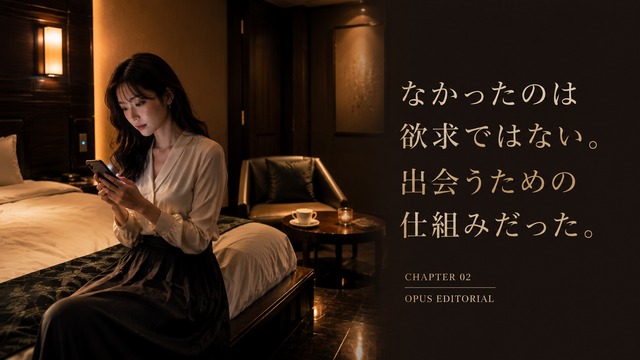
    What Was Missing Was Not Women’s Desire,
    but a Way to Meet

    Awareness of adult services for women has only begun to grow relatively recently. Yet it is difficult to believe that women only recently began seeking intimate time with men.

    Wanting to be held by someone. Wanting to be treated as someone special. Wanting to feel safe enough to surrender physically. Wanting to express desires that cannot be shared with a partner. Such feelings have certainly existed for generations. What was missing was not the desire itself, but a system that allowed women to express it safely and meet someone who matched their wishes.

    “I don’t know where to go.” “I can’t tell whether it is safe.” “I would be embarrassed if anyone found out.” For many years, the difficulty of accessing and sharing information created a barrier to using these services. With the widespread adoption of smartphones, however, it has become commonplace for people to compare options, make reservations and pay for services on their own terms.

    Women can reserve the time they want and pay for it themselves. Adult services for women are a natural choice that has emerged as an extension of modern women’s freedom and independence.

    Find the time and peace of mind you desire with OPUS.

    Go to the OPUS Homepage
    \n\n
  • 01 | Why Sexual Services for Women Did Not Become Widespread Until Recently | OPUS

    01 | Why Sexual Services for Women Did Not Become Widespread Until Recently | OPUS

    What Are Sexual Services for Women? | Five Chapters

    CHAPTER 01 / 05

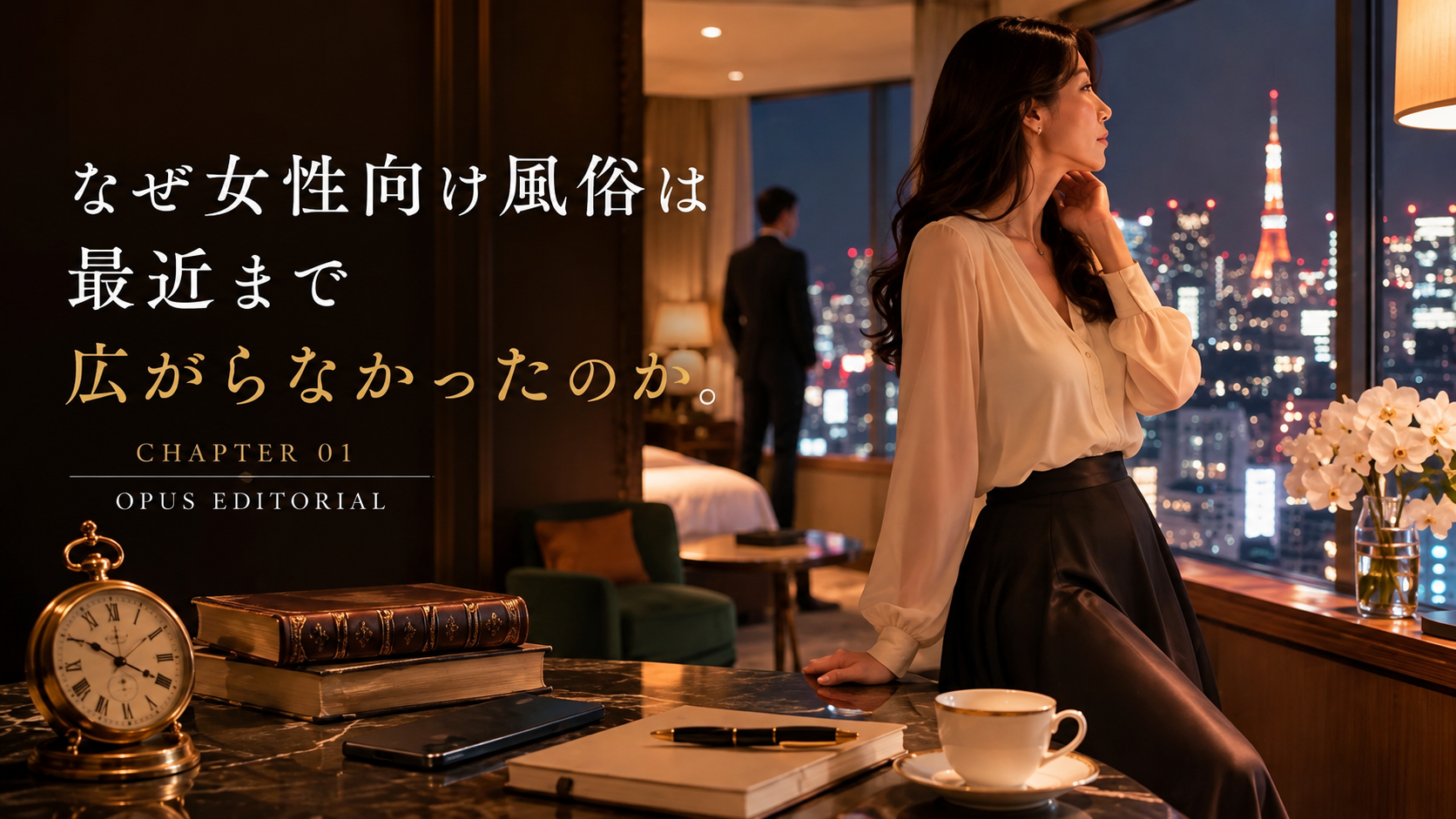
    Why Sexual Services for Women
    Did Not Become Widespread Until Recently

    If you have never used “sexual services for women,” it may be difficult to imagine what such a service is like. To begin, let us briefly look back at why sexual services were long regarded as something intended for men.

    Society has changed dramatically over the past several centuries.

    We have moved from an age of travelling by horse to one of cars and aeroplanes. From letters and landlines, we have entered an age in which smartphones connect us with people around the world. Today, AI is also becoming part of everyday life.

    The way we live and work, as well as the roles of women and men, have gradually changed.

    Even so, the image that comes to mind for many people when they hear “sexual services” remained almost unchanged for a very long time.

    Men used the establishments, and women provided the services. This arrangement came to be accepted as though it were entirely natural.

    So where, in all of this,
    were women’s feelings considered?

    Women, too, have days when they want someone to treat them tenderly. There are days when they want to be held, and days when they want to be seen and desired as a woman.

    At times, they may seek physical satisfaction outside the context of romance. Yet for many years, it was considered difficult for women to speak openly about such feelings.

    Women were expected to be the ones who were desired, not the ones who chose men for themselves. Perhaps assumptions like these delayed the development of services created for women.

    Sexual services for women did not create women’s desires. Rather, they can be seen as choices that are finally becoming available for feelings that have always existed.

    Discover an OPUS private experience designed around women’s feelings.

    Visit the OPUS Homepage
    \n\n
  • Why Does Love Make Us Feel Lonely? | OPUS

    Why Does Love Make Us Feel Lonely? | OPUS

    OPUS EDITORIAL / COLUMN

    Why does love
    make us feel lonely?

    On love, validation and loneliness—the feelings happiness alone cannot explain. A story about a woman rediscovering the self she had forgotten.

    NEWS & VOICE OPUS COLUMN READING TIME 7 MIN.

    Why does love sometimes feel lonely?

    We tend to believe that falling in love
    makes us happy.

    Of course, that is not untrue. Yet for many women, love does not end with happiness alone. In an unguarded moment, it can bring an overwhelming loneliness with it.

    01

    Where does
    that loneliness come from?

    It is difficult to explain the reason in words.

    Are we lonely because we have fallen for someone? Are we lonely because we cannot see them? It does not seem quite that simple.

    Somewhere in the hearts of many women is a desire to feel validated.

    • To be praised.
    • To be treated with care.
    • To be seen as someone special.
    • To be needed.

    That is neither selfish nor extravagant.

    Perhaps it is an extension of the sense of security we all received so naturally as children.

    02

    From being protected
    to becoming the protector.

    To be protected by someone. To be told that you belong here.

    As we grow older, that warmth gradually fades away.

    Before she realises it, a woman is no longer the one being protected, but the one doing the protecting.

    For her children. For her family. For her partner or husband. At work and in her relationships, too, she is often expected to be mindful of everyone around her.

    There is beauty in that. But being beautiful does not make it any less exhausting.

    The more someone continues to support others,
    the fewer opportunities she has to be supported herself.

    ON CARE, LOVE AND LONELINESS

    03

    Are men to blame?

    It may be easy to reach that conclusion. But reality is more complicated.

    Many men are unaware of the subtle shifts in emotion that women experience.

    There is no ill intent. They simply do not notice.

    And so women hope, “I want him to understand without being told,” while men think, “I cannot understand unless you tell me.”

    That disconnect is not the responsibility of one person alone.

    Even when the emptiness within seems to have found an explanation, it quietly returns.

    It dissolves into the busyness of everyday life, until eventually she tells herself, “This is simply how it is.”

    Many women repeat this cycle.

    04

    You do not have to carry
    that emptiness for the rest of your life.

    Must that emptiness be something a woman carries for her entire life simply because she is a woman?

    I want to believe that it need not be.

    As it was in our youth.

    When the thought of seeing someone made your heart race, and you spent just a little longer getting ready in front of the mirror.

    There is no need to lose from your life the joy you once felt simply at being able to see someone.

    We cannot turn back time. But the moment when the heart begins to stir again can come at any age.

    05

    Rediscovering
    the self you had forgotten.

    • To be needed.
    • To be looked at.
    • To be treated as a woman.
    • To feel safe enough to let go.

    This is not an escape into the past.

    It is time to rediscover the self you had forgotten.

    06

    Not an escape from the everyday,
    but time to reclaim what has been lost.

    OPUS does not seek to offer an escape from everyday life itself.

    It offers time to rediscover the excitement and reassurance that have gradually faded from daily life.

    Not someone’s mother. Not someone’s wife. Not someone’s subordinate.

    To smile as a woman, to be desired as a woman, and to set your heart free as a woman.

    That time is never intended as an escape from reality.

    It is time that allows you to begin walking forward again tomorrow, true to yourself.

    Opus

    To nourish the heart
    and quietly rediscover the joy of being a woman.

    OPUS aspires to be a place where women can nourish their hearts and quietly rediscover the joy of being a woman.

    \n\n
  • [5 Chapters | Chapter 5] Being Able to Stand on Your Own Is Not the Same as Wanting to Be Alone

    [5 Chapters | Chapter 5] Being Able to Stand on Your Own Is Not the Same as Wanting to Be Alone

    Why Are Career Women More Likely to Feel Lonely? | 5 Chapters

    CHAPTER 05 / 05

    Being Able to Stand on Your Own Is Not the Same as Wanting to Be Alone

    Independence does not mean needing no one. It means being able to choose whom you need.

    I once met a woman of around thirty who possessed both beauty and intelligence. She said she had a boyfriend, yet she blushed when our hands merely touched.

    Later, when we became deeply intimate, she confided that it had been her first time. She was not a woman no one had chosen.

    Perhaps it was precisely because she seemed capable of living on her own that no one had found it easy to step into her life.

    You have already worked hard enough. It is all right to let your guard down a little when you are with someone.

    Independence does not mean needing no one.
    It means being able to choose whom you need.

    You do not have to be strong all the time.
    Find a place where you can safely explore how you truly feel.

    Discover OPUS
    \n\n
  • [5 Chapters | Chapter 3] What Is It About These Women That Men Fear?

    [5 Chapters | Chapter 3] What Is It About These Women That Men Fear?

    Why Are Career Women More Likely to Feel Alone? | 5 Chapters

    CHAPTER 03 / 05

    What Is It About These Women That Men Fear?

    Men, too, find themselves caught between Showa-era values and the realities of the Reiwa era. When they feel unsure around independent women, it does not necessarily mean they dislike their competence.

    Be a man who can support his family and protect a woman. At the same time, treat women as equals, do not try to control them, and put your emotions into words. Men, too, face the conflicting expectations of two different eras.

    A woman who can live independently may be mistaken for a woman who wants to be alone.

    Yet what she may be looking for is not someone to solve her problems, but a space where she can feel safe enough to let her guard down.

    When a man keeps his distance, it does not necessarily mean rejection. Sometimes, because he knows he cannot treat you casually, he simply does not know how to approach you.

    “What could I possibly add
    to this woman’s life?”

    You do not always have to be strong.
    Come to a place where you can safely explore how you truly feel.

    Learn About OPUS
    \n\n
  • 【Five Chapters | Chapter 4】Being in the Same Place Doesn’t Mean We’ve Lived the Same Life

    【Five Chapters | Chapter 4】Being in the Same Place Doesn’t Mean We’ve Lived the Same Life

    Why Are Career Women More Likely to Feel Lonely? | Five Chapters

    CHAPTER 04 / 05

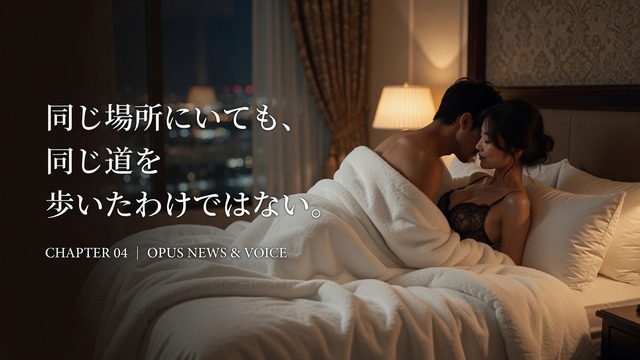
    Being in the Same Place Doesn’t Mean We’ve Lived the Same Life

    You know what you had to overcome to get this far. But the path the person before you has taken remains hidden behind who they are today.

    The same university, the same company, a similar income. So you assume that the other person is “someone on your level.”

    Yet he, too, may have lived under pressure to deliver results, hiding his vulnerability and continually proving his worth.

    She thinks, “He probably won’t see me as special,” while he thinks, “She probably doesn’t need someone like me.”

    What lies between them is not a difference in ability. It is the fact that neither can see the journey that brought the other here.

    Though they are so close,
    neither can see the other’s journey.

    You don’t always have to be strong.
    Discover a place where you can explore your feelings with confidence.

    Learn About OPUS
    \n\n
  • [Five Chapters | Chapter 2] The More Capable a Woman Is, the More She Sees Herself as “Ordinary”

    [Five Chapters | Chapter 2] The More Capable a Woman Is, the More She Sees Herself as “Ordinary”

    Why Are Career Women More Likely to Feel Lonely? | Five Chapters

    CHAPTER 02 / 05

    The More Capable a Woman Is, the More She Sees Herself as “Ordinary”

    We evaluate ourselves according to the world we live in. The more a woman has already achieved, the more likely she is to see it not as exceptional, but simply as part of everyday life.

    If you are surrounded by highly educated, high-earning people, your own accomplishments may not seem exceptional. Your intelligence, career and appearance are simply part of the life you have built through sustained effort.

    A woman thinks, “He must know plenty of women like me.” A man thinks, “Someone like her would never be interested in me.”

    As a result, she believes she was not chosen, while he believes he could not approach her. Yet neither is rejecting the other.

    It is not that you lack appeal. You are simply the only person treating that appeal as something ordinary.

    “I’m just ordinary.”
    From her perspective, that is genuinely how she sees herself.

    You do not have to be strong all the time.
    Come to a place where you can explore your feelings with confidence.

    Discover OPUS
    \n\n
LINEで相談する