
What changed—
only desire?
“Lately, I feel like I want sex more than I used to.”
Have you ever found yourself thinking that on a quiet night?
Perhaps it began in your thirties.
Or perhaps in your forties.
The shape of your own desire seems clearer than it once did.
There are nights when you miss another person’s warmth.
Nights when you want to be held.
And nights when, quite simply—you want sex.
And yet, there is something curious about it.
If this were only about the body, why should it feel so present now?
grown stronger?
Or perhaps.
What changed was not desire itself, but the life surrounding it.
Sometimes, that is what I wonder.
Only three words.
Yet behind them can lie years that three words could never contain.
Today, let us follow that time backwards for a little while.
Does desire really grow stronger
in your forties?

You sometimes hear that women become more sexually driven in their forties.
But female desire does not seem simple enough to trace a single, elegant curve according to age.
The body changes with time.
But a person is more than a body.
So let us turn the clock back a little.
When there was no reason to hurry toward the future
In your teens and twenties.
You could talk with friends for hours.
You could suddenly ask, “Want to meet now?”
Falling for someone could make the whole day look different.
There were places you had never visited, people you had never met, and experiences you had not yet had.
Tomorrow felt as though something might happen.
Next year seemed to hold even more.
The future stretched so far ahead that there was little reason to hurry.
Of course, no two women lived exactly the same life.
Still, one thing may be true.
Between then and now, it is not only desire that has changed.
The world surrounding desire has changed too.
If so, perhaps it is unfair to measure the “I want sex” of then and now with the same ruler.
Maybe desire did not change.
Maybe everyday life did.
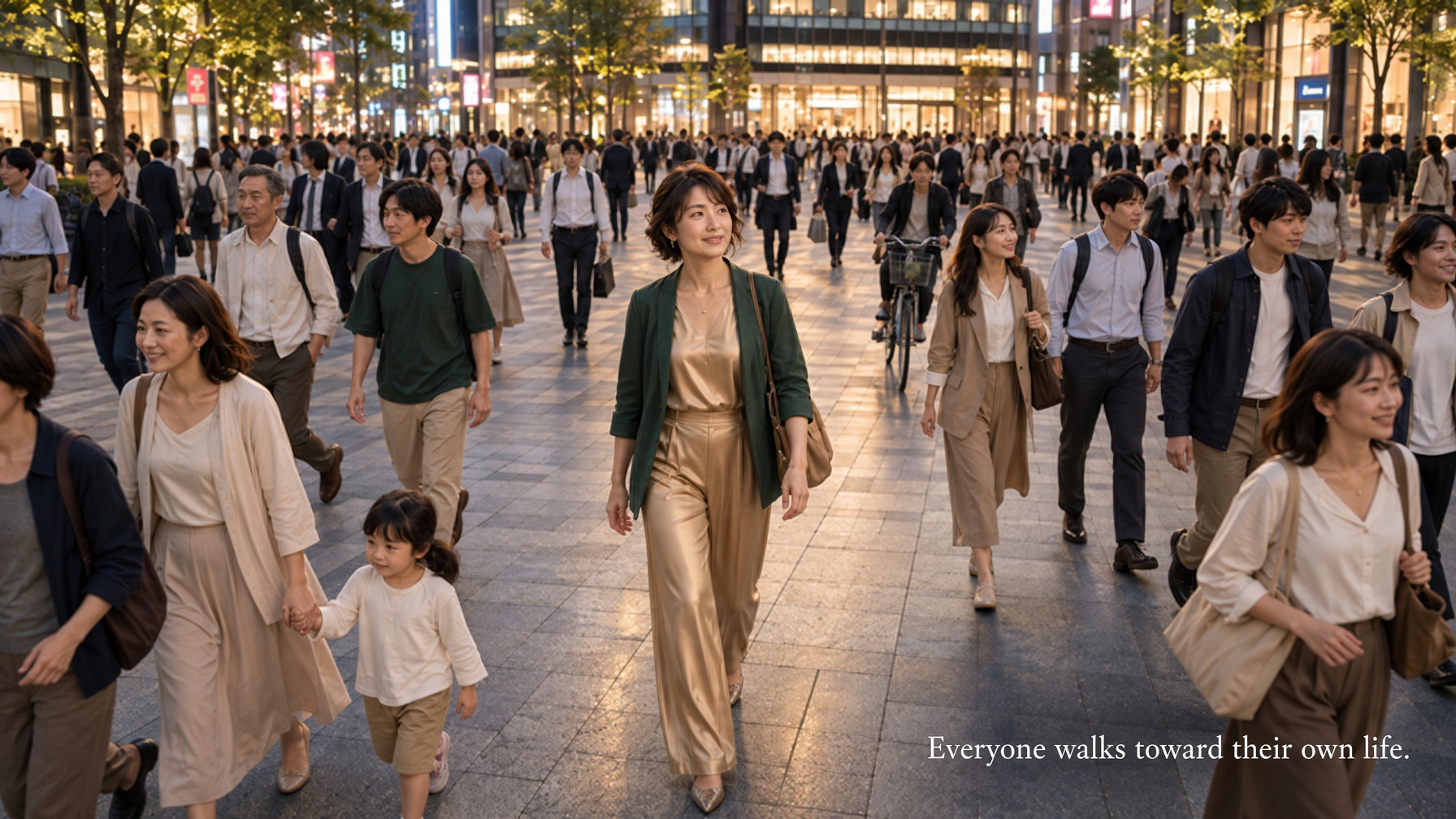
We do not become adults all at once.
The scenery of our lives changes so quietly that we hardly notice it happening.
A close friend gets married.
Another has a child.
Work begins to ask more of us.
Someone moves far away.
And we, too, build lives of our own.
went home to a life of their own.
There is something beautiful in that.
But at night, the room can still be quiet.
The person you once could call and see at a moment’s notice now has a schedule of her own.
An evening once filled with laughter may quietly become an evening alone with a favorite video on your phone.
You are freer than before.
And sometimes that freedom feels strangely vast.
There are nights like that.
Has my desire become stronger?
Or have I simply become more aware
of the warmth that is no longer beside me?
In words, these are separate things.
But our hearts are not arranged as neatly as a dictionary.
The border between longing for someone and sexual desire may always be a little blurred.
Where does loneliness end, and desire begin?
Some nights, even we cannot say.
And in our thirties and forties, that faint sense of having been left behind by time may sometimes be understood as “stronger desire.”
The woman who did not know yet,
and the woman who knows now

Before you knew sex.
It belonged partly to imagination.
What would it feel like to have sex with someone you loved?
Hearing friends talk about their experiences may once have left you feeling a little behind.
Or perhaps you felt it had nothing to do with you yet.
But once we know something, we can begin to understand what we truly want from it.
You learn the warmth of another body.
The reassurance of being held.
You learn happy nights.
And nights tinged with sadness.
Nights that were less than you hoped.
And nights you would rather not forget.
Experience is not a competition in numbers.
It is, perhaps, the gradual discovery of what feels right to you—and what does not.
What you can do and what you want are not the same.
It is not that you do not know how to meet someone.
If you truly wanted to, you know there are ways.
But—
and what you want are different.
Simply being able to have sex is not enough.
The way someone chooses words.
The way distance slowly closes.
The time allowed before a touch.
The way that person sees you.
Experience teaches us that all of this can become part of a single night.
I want sex.
But I do not want just anyone.
It may look contradictory. It is not.
Perhaps you simply understand what you want more clearly than you once did.
Maybe that is all.
When you realize that “someday”
cannot wait forever

Time makes no sound.
There is no sound at the border between yesterday and today.
Yet an old photograph can suddenly show us that time has undeniably passed through our lives.
Twenty years.
Sometimes the numbers themselves are startling.
In our teens and twenties, the future could feel almost inexhaustible.
“Someday, I’ll go.”
“Someday, I’d like to try.”
“Someday, when I meet someone wonderful.”
That “someday” could always be moved farther away.
In our thirties and forties, the future can begin to look a little different.
There is no need for pessimism.
Life continues.
We can still fall in love.
We can travel.
We can wear beautiful clothes.
We can love someone, and be held by someone.
There is simply one thing we may understand more clearly.
Time is not infinite.
Our bodies change.
The woman in the mirror changes.
And life itself will one day have an evening.
Perhaps we simply become more conscious of that, little by little.
A rose in full bloom is precious partly because it cannot remain at that moment forever.
—Though perhaps there is no need to make it sound quite so grand.
Once we understand that things have endings,
“someday” becomes a slightly less dependable word.
There was a place you wanted to visit.
A street in another country you wanted to walk.
You wanted to fall deeply in love.
You wanted to be held with care.
You wanted to know a little more about what kinds of pleasure your own body could feel.
How long should those wishes remain in a box marked “someday”?
becomes “I want to now.”
If, in your thirties or forties, you feel that your desire is stronger than before, perhaps it is not only because something inside your body has increased.
Perhaps you also want to use more of the time still ahead for yourself.
On some nights, that quiet intention may take the shape of sexual desire.
What lies behind
“I want sex”

Working in a private service created for women changes the way one hears the words “I want sex.” They rarely sound like desire alone.
Behind those three words are different lives.
You may miss the warmth of another person.
You may want to relax for a while in the arms of a professional companion.
You may want to put down the roles of everyday life and simply feel like a woman again.
You may want to feel that small spark of excitement.
You may want to feel at home in your own body again.
Or there may be no story at all.
Each feeling belongs to the woman who feels it.
There is no hierarchy and no competition.
You do not need to invent a beautiful reason for it.
Perhaps your desire has not increased at all.
There was a “want” that belonged to then.
And there is a “want” that belongs to now.
Which one is stronger may not matter very much.
What matters is what happens when you hear that voice.
Perhaps you do not have to pretend you did not hear it.