EXPERIENCE JAPAN WITH SOMEONE|8 CHAPTERS
CHAPTER 04 / 08
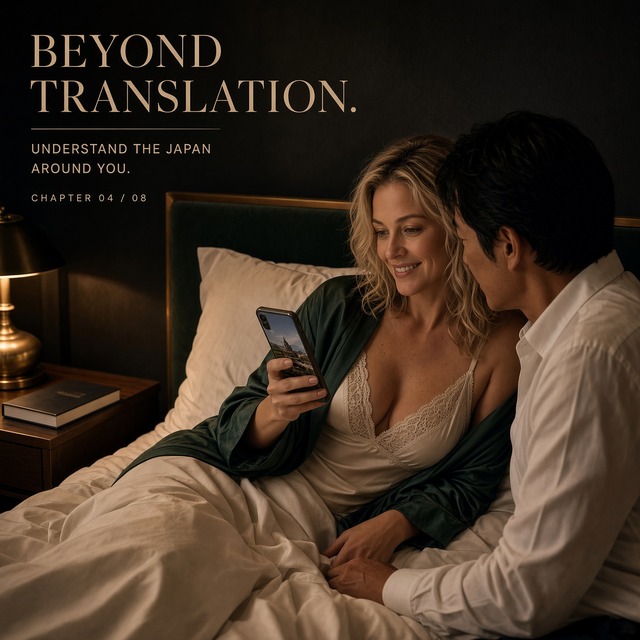
Beyond Translation|Understanding the Japan Around You
Translation tells you what was said.
Translation tells you what was said.
Sometimes the more interesting question is why it was said.
That is where conversation begins.
Translation Is Useful. Context Changes the Experience.
Translation technology is extraordinary.
It can translate a sign, a menu, an announcement or a sentence within seconds.
But words are only one layer of what you encounter in Japan.
Why is the announcement necessary? Why is everyone behaving in the same way? Why is this building important to people who live here?
Those questions require more than replacing Japanese words with English words.
A Sumo Match Is More Than the Words in the Arena.
At sumo, you may want to know what the announcement says.
But you may also wonder why spectators react in a certain way, what the referee is doing, why some wrestlers have different hairstyles, or why particular rituals occur before the bout.
A literal translation can answer one part.
A person beside you can connect the words to history, custom and what is happening in front of you.
And he can explain only as much as you actually want to know.
Tokyo Tower and Tokyo Skytree Are More Than Directions on a Map.
A navigation app can tell you how to reach Tokyo Tower or Tokyo Skytree.
But perhaps you want to know why Tokyo Tower still has emotional meaning to many Japanese people even after a newer tower was built.
Perhaps you want to know what local people actually think about a landmark that appears in international guidebooks.
Those are not questions of navigation.
They are questions about how a place lives inside a culture.
The Explanation Can Change With the Woman Asking.
A good explanation is not simply accurate.
It fits the person listening.
If you already know Japanese history, you do not need a beginner's explanation.
If you have just arrived in Japan for the first time, you should not be expected to know what locals take for granted.
Your Companion can see your face, hear your question and adjust.
That is something a static guidebook cannot do.
A translation app can tell you what was said. But what if you want to know why?
The most interesting questions about Japan often appear only after you arrive.
YOUR NEXT STEP
Choose the guide that fits where you are now.
 01 — GUIDE
Complete Guide for First-Timers
Pricing, safety, how the service works and what intimacy can mean—explained clearly before you decide.
READ THE COMPLETE GUIDE 02 — 120 MINUTES
Your Standard 120 Minutes
A calm, step-by-step example of how your first 120 minutes with OPUS may unfold.
EXPLORE THE 120-MINUTE EXPERIENCEFROM CHECK-IN TO CHECK-OUT
Understand the Japan around you.
FROM CHECK-IN TO CHECK-OUT can include conversation, translation and cultural context — always according to what you actually want to know.
ENGLISH RESERVATIONEXPERIENCE JAPAN WITH SOMEONE|8 CHAPTERS
All 8 Chapters
This article is part of an eight-chapter OPUS TOKYO series about FROM CHECK-IN TO CHECK-OUT, a private adult companion experience for women.
- 01 You Can Visit Japan Alone. But You Do Not Have to Experience It Alone.
- 02 FROM CHECK-IN TO CHECK-OUT Is Not a Tour. It Is an Adult Companion Experience for Women.
- 03 Plan Everything. Plan Nothing. Change Everything.
- 04 Beyond Translation|Understanding the Japan Around You
- 05 Sushi Without a Menu?|What Japan Does Not Always Explain
- 06 I'm a Foreigner. Am I Really Welcome?
- 07 Privacy, Payment and the Things You Should Not Have to Worry About
- 08 You Can Wait for the Right Person. You Do Not Have to Wait for the Right Time.