EXPERIENCE JAPAN WITH SOMEONE|8 CHAPTERS
CHAPTER 05 / 08
Sushi Without a Menu?|What Japan Does Not Always Explain
A restaurant can be easy to find online.
A restaurant can be easy to find online.
Understanding whether it is right for you can be much harder.
Sushi is one example of the difference.
Some Sushi Restaurants Do Not Work Like the Restaurants You Know.
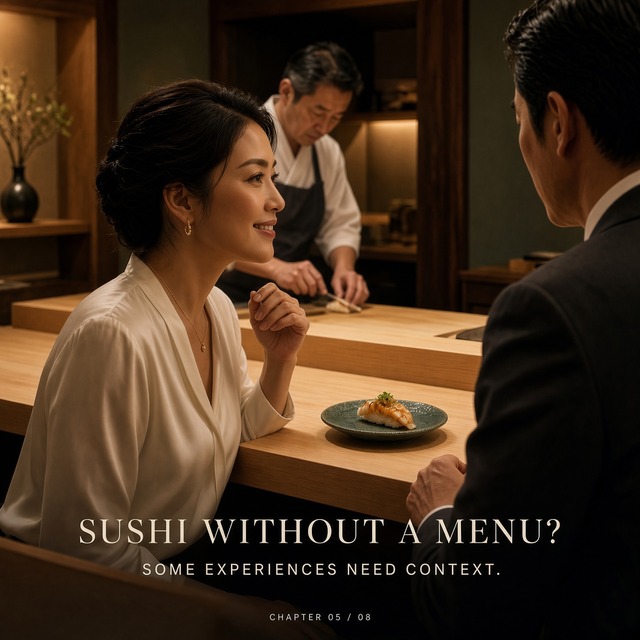
At a certain level, a Japanese sushi restaurant may not have the kind of fixed menu a visitor expects.
The reason is not necessarily secrecy.
The ingredients can change with the season, the day's supply, preparation and the chef's judgment.
The order in which pieces are served may also be part of the experience.
For someone unfamiliar with that style, the absence of a familiar menu can feel less like luxury and more like risk.
The Difficult Part Is Often What Is Not Written.
How do you reserve? Is there an English menu? Is the price obvious? How do you order when the meal is largely omakase?
Does the restaurant have its own customs? Does it primarily serve repeat customers or introductions?
These questions are not proof that the restaurant dislikes foreign guests.
A busy established restaurant may simply operate around customers who already understand its rhythm.
The result, however, can still feel intimidating to someone arriving alone.
Understanding the Story Behind the Meal Changes the Meal.
Why this fish now? Why this preparation? Why this order?
A chef may have reasons connected to season, temperature, texture, preparation or the progression of the meal.
Even many Japanese customers may not be able to explain every detail.
That uncertainty is part of what makes the experience interesting.
The point is not that FROM CHECK-IN TO CHECK-OUT is a sushi service.
The point is that many experiences in Japan become richer when someone beside you can help you enter the context.
The Best Restaurant Is Not Always the Most Famous One.
Search rankings naturally favor places that can be found, reviewed and explained easily.
But the restaurant best suited to you may depend on what you enjoy, what you dislike, how adventurous you feel and how much uncertainty you want.
A Companion can help translate not only words, but preference.
He can ask what matters to you before deciding what kind of experience actually fits.
Finding a restaurant is easy. Understanding whether it is right for you is different.
Sushi is only one example. Japan contains many experiences whose meaning is not fully visible from the outside.
YOUR NEXT STEP
Choose the guide that fits where you are now.
 01 — GUIDE
Complete Guide for First-Timers
Pricing, safety, how the service works and what intimacy can mean—explained clearly before you decide.
READ THE COMPLETE GUIDE 02 — 120 MINUTES
Your Standard 120 Minutes
A calm, step-by-step example of how your first 120 minutes with OPUS may unfold.
EXPLORE THE 120-MINUTE EXPERIENCEFROM CHECK-IN TO CHECK-OUT
Some experiences need context.
The goal is not to turn your day into a guided tour. It is to make the Japan around your private relationship easier to enter and enjoy.
ENGLISH RESERVATIONEXPERIENCE JAPAN WITH SOMEONE|8 CHAPTERS
All 8 Chapters
This article is part of an eight-chapter OPUS TOKYO series about FROM CHECK-IN TO CHECK-OUT, a private adult companion experience for women.
- 01 You Can Visit Japan Alone. But You Do Not Have to Experience It Alone.
- 02 FROM CHECK-IN TO CHECK-OUT Is Not a Tour. It Is an Adult Companion Experience for Women.
- 03 Plan Everything. Plan Nothing. Change Everything.
- 04 Beyond Translation|Understanding the Japan Around You
- 05 Sushi Without a Menu?|What Japan Does Not Always Explain
- 06 I'm a Foreigner. Am I Really Welcome?
- 07 Privacy, Payment and the Things You Should Not Have to Worry About
- 08 You Can Wait for the Right Person. You Do Not Have to Wait for the Right Time.