Tag: Women Traveling Japan

  • Privacy and Payment|CHAPTER 07 / 08

    Privacy and Payment|CHAPTER 07 / 08

    EXPERIENCE JAPAN WITH SOMEONE|8 CHAPTERS

    CHAPTER 07 / 08

    Privacy, Payment and the Things You Should Not Have to Worry About

    Privacy should stay private.

    07 EXPERIENCE JAPAN WITH SOMEONE|8 CHAPTERS

    Privacy should stay private.

    Payment should be understandable before the day begins.

    A woman should not need to trade unnecessary personal information for reassurance.

    We Do Not Need to Know Everything About You.

    A private service needs enough information to complete a reservation safely and correctly.

    That does not mean every personal fact is relevant.

    Your real name, home address, occupation, public profile or personal history should not automatically become subjects of interest simply because you made a reservation.

    The most secure personal information is often the information a business never collects.

    What Your Companion Learns Personally Should Stay Personal.

    A private conversation may naturally reveal where you live, what you do, what kind of life you have or why you came to Japan.

    Those details may matter to the relationship between you and your Companion in that moment.

    They do not automatically become useful business information for OPUS.

    The distinction matters.

    Private conversation should not become internal entertainment.

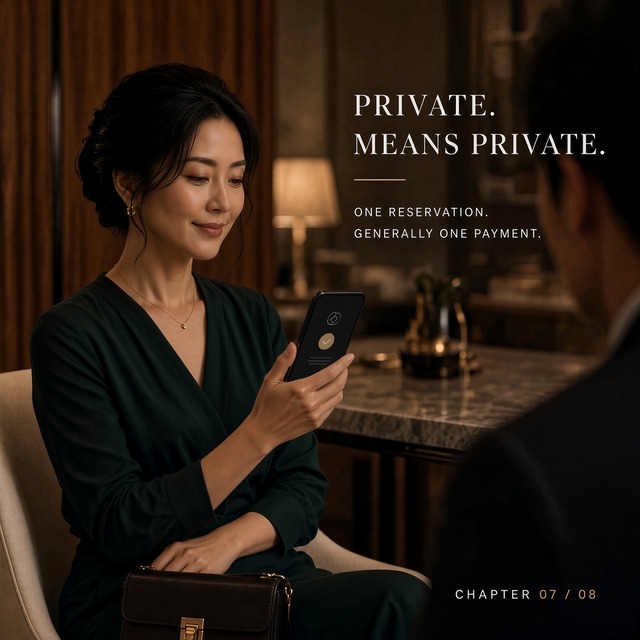
    One Reservation. Generally One Payment.

    OPUS is designed so that payment is generally completed when the reservation is confirmed.

    A second payment should not suddenly appear merely because the day has begun.

    The main situations in which another payment may occur are limited: for example, when you choose to extend the time or when you personally request an additional arrangement.

    Even then, the decision should be yours.

    Having a man unexpectedly make you open your handbag and take out your wallet in the middle of a private experience is not the image of gentlemanly service OPUS wants to create.

    The Best Defense Against a Data Leak Is Not Holding Data You Do Not Need.

    Credit-card payments are handled through a payment processor.

    OPUS does not need to build a business around possessing unnecessary card information.

    The same principle applies more broadly.

    Collect less. Share less. Ask only what is relevant.

    Privacy should be designed into the service rather than promised only after information has already been collected.

    Private means private.

    One reservation. Generally one payment. Only the information necessary to provide the service should need to move through the system.

    FROM CHECK-IN TO CHECK-OUT

    Privacy should stay in your hands.

    OPUS aims to reduce unnecessary questions, unnecessary payment uncertainty and unnecessary exposure of personal information.

    ENGLISH RESERVATION
    \n\n
  • You Do Not Have to Wait for the Right Time|CHAPTER 08 / 08

    You Do Not Have to Wait for the Right Time|CHAPTER 08 / 08

    EXPERIENCE JAPAN WITH SOMEONE|8 CHAPTERS

    CHAPTER 08 / 08

    You Can Wait for the Right Person. You Do Not Have to Wait for the Right Time.

    Of course, you could experience Japan this way with a real partner.

    08 EXPERIENCE JAPAN WITH SOMEONE|8 CHAPTERS

    Of course, you could experience Japan this way with a real partner.

    The question is not whether that is possible.

    The question is when.

    Of Course, You Could Do This With a Real Partner.

    A real boyfriend could walk Tokyo with you, change plans with you, explain things, eat with you, take care of you when you are tired and return to the hotel with you.

    There is nothing artificial about wanting that.

    The uncertainty is time.

    No one can tell you when the right person will appear.

    And even when he does, no one can guarantee that this particular trip to Japan will still be waiting.

    You May Want to Experience Japan Now.

    Perhaps your flight is already booked.

    Perhaps you finally have the time.

    Perhaps you spent years prioritizing work, family or other people's needs and this trip belongs to you.

    Waiting for the right person is one decision.

    Waiting to enjoy your own present life is another.

    They do not have to be the same decision.

    You May Visit the Same Japan — and Go Home With a Completely Different Experience.

    The city will be the same.

    Tokyo Tower will still stand in the same place. Sushi will still be served. Trains will still arrive.

    What changes is the relationship inside the experience.

    Someone notices when you are tired. Someone laughs with you when the plan fails. Someone answers the question that occurred only five seconds ago.

    Someone returns to the hotel with you.

    That changes what you take home.

    Not Someone Showing You Japan. Someone Experiencing Japan With You.

    That is the idea behind FROM CHECK-IN TO CHECK-OUT.

    It is not tourism disguised as romance.

    It is a private adult companion experience in which the Japan around you may become part of the relationship.

    You can plan everything or nothing.

    You can talk about history or forget history completely.

    You can stay outside or return to the hotel.

    The center is not Japan alone.

    The center is how you want to feel while you are here.

    You can wait for the right person. You do not have to wait for the right time.

    Japan may be the same place. The experience you carry home does not have to be.

    FROM CHECK-IN TO CHECK-OUT

    Experience the Japan you want now.

    FROM CHECK-IN TO CHECK-OUT brings the city, conversation, companionship and private adult intimacy into one continuous experience.

    ENGLISH RESERVATION
    \n\n
  • I’m a Foreigner. Am I Really Welcome?|CHAPTER 06 / 08

    I’m a Foreigner. Am I Really Welcome?|CHAPTER 06 / 08

    EXPERIENCE JAPAN WITH SOMEONE|8 CHAPTERS

    CHAPTER 06 / 08

    I'm a Foreigner. Am I Really Welcome?

    "I am a foreigner. Am I really welcome?"

    06 EXPERIENCE JAPAN WITH SOMEONE|8 CHAPTERS

    "I am a foreigner. Am I really welcome?"

    It is a reasonable question.

    You should not need to carry that uncertainty into a private experience.

    You Do Not Need to Prove That You Belong Here.

    At OPUS, where you were born, the color of your skin, the language you speak, your religion or the passport you carry does not decide how you are treated.

    You do not need Japanese in order to deserve respectful service.

    Being unfamiliar with Japan is not something to apologize for.

    You are a woman choosing a private adult experience. That is the starting point.

    You Do Not Need Japanese to Choose OPUS.

    You may know no Japanese at all.

    That does not mean you should be placed in situations where you are embarrassed for not understanding a custom that local people consider obvious.

    Necessary rules still matter and will be explained.

    But not knowing something should not become an excuse to blame you, shame you, charge you unexpectedly or treat you as less deserving than a Japanese customer.

    Not Knowing Japan Should Never Become Your Disadvantage.

    A large part of travel stress comes from uncertainty.

    What happens next? Is there another charge? Did I misunderstand something? Was I supposed to know that rule already?

    OPUS tries to move those questions forward in time.

    If something can affect your decision, cost or schedule, the goal is to explain it before you must decide.

    You should not discover the important part only after the consequence has already occurred.

    We Would Rather Protect Your Dignity Than Test Your Knowledge of Japan.

    You did not come to Japan to pass an examination in Japanese culture.

    A private Companion should not stand beside you waiting for you to make a mistake.

    If a cultural difference creates confusion, he can help.

    If you need him to speak first at the hotel, he can take the lead.

    If something unexpected happens, you should not suddenly be left alone to solve Japan by yourself.

    Not knowing Japan should never become your disadvantage.

    You do not need perfect Japanese. You do not need any Japanese at all to deserve clarity, dignity and equal treatment.

    FROM CHECK-IN TO CHECK-OUT

    Yes. As you are.

    OPUS is designed so that unfamiliar language, customs or local knowledge do not have to become additional anxiety.

    ENGLISH RESERVATION
    \n\n
  • Beyond Translation|Understanding Japan|CHAPTER 04 / 08

    Beyond Translation|Understanding Japan|CHAPTER 04 / 08

    EXPERIENCE JAPAN WITH SOMEONE|8 CHAPTERS

    CHAPTER 04 / 08

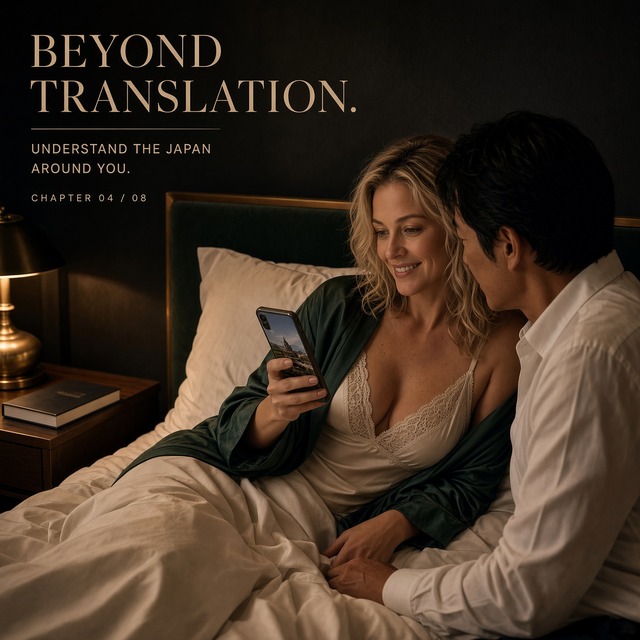
    Beyond Translation|Understanding the Japan Around You

    Translation tells you what was said.

    04 EXPERIENCE JAPAN WITH SOMEONE|8 CHAPTERS

    Translation tells you what was said.

    Sometimes the more interesting question is why it was said.

    That is where conversation begins.

    Translation Is Useful. Context Changes the Experience.

    Translation technology is extraordinary.

    It can translate a sign, a menu, an announcement or a sentence within seconds.

    But words are only one layer of what you encounter in Japan.

    Why is the announcement necessary? Why is everyone behaving in the same way? Why is this building important to people who live here?

    Those questions require more than replacing Japanese words with English words.

    A Sumo Match Is More Than the Words in the Arena.

    At sumo, you may want to know what the announcement says.

    But you may also wonder why spectators react in a certain way, what the referee is doing, why some wrestlers have different hairstyles, or why particular rituals occur before the bout.

    A literal translation can answer one part.

    A person beside you can connect the words to history, custom and what is happening in front of you.

    And he can explain only as much as you actually want to know.

    Tokyo Tower and Tokyo Skytree Are More Than Directions on a Map.

    A navigation app can tell you how to reach Tokyo Tower or Tokyo Skytree.

    But perhaps you want to know why Tokyo Tower still has emotional meaning to many Japanese people even after a newer tower was built.

    Perhaps you want to know what local people actually think about a landmark that appears in international guidebooks.

    Those are not questions of navigation.

    They are questions about how a place lives inside a culture.

    The Explanation Can Change With the Woman Asking.

    A good explanation is not simply accurate.

    It fits the person listening.

    If you already know Japanese history, you do not need a beginner's explanation.

    If you have just arrived in Japan for the first time, you should not be expected to know what locals take for granted.

    Your Companion can see your face, hear your question and adjust.

    That is something a static guidebook cannot do.

    A translation app can tell you what was said. But what if you want to know why?

    The most interesting questions about Japan often appear only after you arrive.

    FROM CHECK-IN TO CHECK-OUT

    Understand the Japan around you.

    FROM CHECK-IN TO CHECK-OUT can include conversation, translation and cultural context — always according to what you actually want to know.

    ENGLISH RESERVATION
    \n\n
  • Sushi Without a Menu?|CHAPTER 05 / 08

    Sushi Without a Menu?|CHAPTER 05 / 08

    EXPERIENCE JAPAN WITH SOMEONE|8 CHAPTERS

    CHAPTER 05 / 08

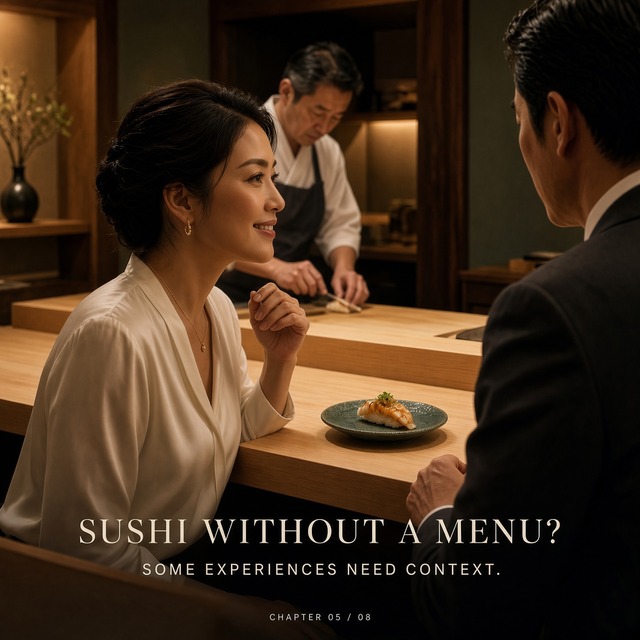
    Sushi Without a Menu?|What Japan Does Not Always Explain

    A restaurant can be easy to find online.

    05 EXPERIENCE JAPAN WITH SOMEONE|8 CHAPTERS

    A restaurant can be easy to find online.

    Understanding whether it is right for you can be much harder.

    Sushi is one example of the difference.

    Some Sushi Restaurants Do Not Work Like the Restaurants You Know.

    At a certain level, a Japanese sushi restaurant may not have the kind of fixed menu a visitor expects.

    The reason is not necessarily secrecy.

    The ingredients can change with the season, the day's supply, preparation and the chef's judgment.

    The order in which pieces are served may also be part of the experience.

    For someone unfamiliar with that style, the absence of a familiar menu can feel less like luxury and more like risk.

    The Difficult Part Is Often What Is Not Written.

    How do you reserve? Is there an English menu? Is the price obvious? How do you order when the meal is largely omakase?

    Does the restaurant have its own customs? Does it primarily serve repeat customers or introductions?

    These questions are not proof that the restaurant dislikes foreign guests.

    A busy established restaurant may simply operate around customers who already understand its rhythm.

    The result, however, can still feel intimidating to someone arriving alone.

    Understanding the Story Behind the Meal Changes the Meal.

    Why this fish now? Why this preparation? Why this order?

    A chef may have reasons connected to season, temperature, texture, preparation or the progression of the meal.

    Even many Japanese customers may not be able to explain every detail.

    That uncertainty is part of what makes the experience interesting.

    The point is not that FROM CHECK-IN TO CHECK-OUT is a sushi service.

    The point is that many experiences in Japan become richer when someone beside you can help you enter the context.

    The Best Restaurant Is Not Always the Most Famous One.

    Search rankings naturally favor places that can be found, reviewed and explained easily.

    But the restaurant best suited to you may depend on what you enjoy, what you dislike, how adventurous you feel and how much uncertainty you want.

    A Companion can help translate not only words, but preference.

    He can ask what matters to you before deciding what kind of experience actually fits.

    Finding a restaurant is easy. Understanding whether it is right for you is different.

    Sushi is only one example. Japan contains many experiences whose meaning is not fully visible from the outside.

    FROM CHECK-IN TO CHECK-OUT

    Some experiences need context.

    The goal is not to turn your day into a guided tour. It is to make the Japan around your private relationship easier to enter and enjoy.

    ENGLISH RESERVATION
    \n\n
  • FROM CHECK-IN TO CHECK-OUT Is Not a Tour|CHAPTER 02 / 08

    FROM CHECK-IN TO CHECK-OUT Is Not a Tour|CHAPTER 02 / 08

    EXPERIENCE JAPAN WITH SOMEONE|8 CHAPTERS

    CHAPTER 02 / 08

    FROM CHECK-IN TO CHECK-OUT Is Not a Tour. It Is an Adult Companion Experience for Women.

    FROM CHECK-IN TO CHECK-OUT is not another way to sell a sightseeing tour.

    02 EXPERIENCE JAPAN WITH SOMEONE|8 CHAPTERS

    FROM CHECK-IN TO CHECK-OUT is not another way to sell a sightseeing tour.

    The places are not the product.

    The relationship is.

    A Tour Shows You Places. A Companion Shares the Time With You.

    A professional tour guide has a valuable role. A good guide knows routes, landmarks, schedules and the practical structure of tourism.

    FROM CHECK-IN TO CHECK-OUT exists for a different purpose.

    OPUS is an adult companion service for women. The emotional center is not how many destinations can be completed in one day.

    It is the feeling of spending that day with someone who is there for you.

    Tokyo Tower, Ginza, a sushi counter or a quiet cafe may become part of the experience. But none of those places is the product itself.

    What matters is who is beside you when you arrive.

    The Places Are Not the Product. The Relationship Is.

    A destination cannot notice that you are tired.

    A landmark cannot ask whether you are cold.

    A guidebook cannot see that you have suddenly become uncomfortable.

    A Companion can.

    That difference changes the meaning of the day.

    You are not simply moving through Japan beside a person who knows the route. You are spending time with someone whose attention is directed toward you.

    Private Time Does Not Have to Begin at the Hotel Door.

    You may want to meet before check-in.

    You may want dinner first. You may want to walk. You may want to shop. You may want to see something that was never part of the original plan.

    Or you may decide that you do not want to go anywhere at all.

    FROM CHECK-IN TO CHECK-OUT can include the time before the hotel because romance does not begin only after entering a room.

    Sometimes intimacy begins in the way someone listens, waits, notices and adapts.

    This Is Still an Adult Companion Experience for Women.

    OPUS is not attempting to become a tourism company.

    The service remains an adult private companion experience.

    The difference is that the private relationship does not have to be separated from the Japan outside the hotel.

    A date can move naturally from the city into a private room.

    Conversation, attraction, care and adult intimacy can belong to the same continuous period of time.

    That continuity is the core of FROM CHECK-IN TO CHECK-OUT.

    The destination is not the product.

    FROM CHECK-IN TO CHECK-OUT is about who is beside you, how he treats you, and how the relationship moves naturally from the city into private time.

    FROM CHECK-IN TO CHECK-OUT

    Not a tour. A private adult companion experience.

    The Japan around you may become part of the experience, but the center of the service is always the relationship between you and your Companion.

    ENGLISH RESERVATION
    \n\n
  • Plan Everything. Plan Nothing. Change Everything.|CHAPTER 03 / 08

    Plan Everything. Plan Nothing. Change Everything.|CHAPTER 03 / 08

    EXPERIENCE JAPAN WITH SOMEONE|8 CHAPTERS

    CHAPTER 03 / 08

    Plan Everything. Plan Nothing. Change Everything.

    Plan everything if that makes you comfortable.

    03 EXPERIENCE JAPAN WITH SOMEONE|8 CHAPTERS

    Plan everything if that makes you comfortable.

    Plan one thing if that is all you care about.

    Or arrive with nothing planned at all.

    The Schedule Exists for You. You Do Not Exist for the Schedule.

    Travel can easily become another form of work.

    Wake up at a fixed time. Reach the next destination. Complete the next reservation. Make sure the day remains efficient.

    But perhaps efficiency is not what you came to Japan to experience.

    With FROM CHECK-IN TO CHECK-OUT, the schedule is allowed to serve you.

    If the original plan stops feeling good, changing it is not a failure.

    Changed Your Mind? Then the Day Can Change Too.

    Perhaps you planned to visit three places but became tired after the first.

    Perhaps the rain started.

    Perhaps Tokyo traffic made the original timing unrealistic.

    Perhaps you passed a cafe and suddenly wanted to stop.

    Perhaps you simply looked at him and thought: I would rather go back to the hotel.

    A relationship can respond to those moments more naturally than a rigid itinerary.

    "I Haven't Planned Anything. You Decide." Is Also a Choice.

    In work, handing every decision to someone else may be unacceptable.

    In private life, sometimes that is exactly what you want.

    You may spend your ordinary life making decisions for employees, family, clients or colleagues.

    On this day, you may not want another task.

    You may simply want to say: I have no plan. Show me what you think I might enjoy.

    That is not irresponsibility. It can be a form of rest.

    A Companion Can Suggest. He Does Not Need to Persuade.

    A suggestion is useful only while it remains a suggestion.

    If you do not want to go somewhere, you do not need to be convinced.

    If you planned something yesterday and dislike the idea today, yesterday's decision does not own you.

    The best plan is the one that still feels right when the moment arrives.

    Your Companion can help create the day. He does not need to force the day to happen.

    The schedule exists for you.

    Rain, heat, fatigue, traffic and mood are not mistakes. They are part of a real day, and a real relationship can move with them.

    FROM CHECK-IN TO CHECK-OUT

    Plan everything. Plan nothing. Change everything.

    Your day does not have to become another obligation. FROM CHECK-IN TO CHECK-OUT can follow the person you are in that moment.

    ENGLISH RESERVATION
    \n\n
  • Boyfriend Experience in Japan for Women|CHAPTER 01 / 08

    Boyfriend Experience in Japan for Women|CHAPTER 01 / 08

    EXPERIENCE JAPAN WITH SOMEONE|8 CHAPTERS

    CHAPTER 01 / 08

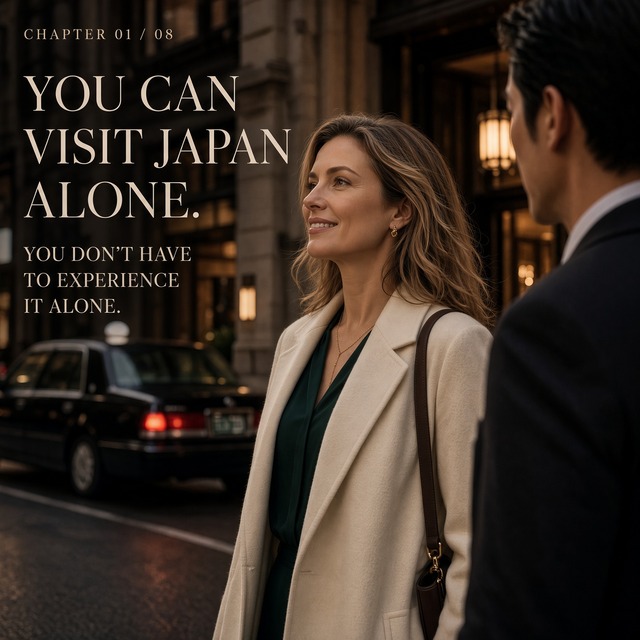
    You Can Visit Japan Alone. But You Do Not Have to Experience It Alone.

    You can travel through Japan alone.

    01 EXPERIENCE JAPAN WITH SOMEONE|8 CHAPTERS

    You can travel through Japan alone.

    But arriving in Japan is not the same as understanding Japan.

    And seeing Japan is not always the same as experiencing it with someone beside you.

    Japan Is Easy to Visit. Understanding It Is Different.

    Flights can be booked online. Trains are remarkably convenient. A smartphone can translate signs, find restaurants, navigate stations and guide you almost anywhere.

    You can arrive in Tokyo, travel across Japan and return home without ever needing someone beside you.

    But Japan contains customs that even Japanese people rarely stop to explain.

    There are rules that may never appear in a guidebook. There are places whose meaning cannot be understood from an address, opening hours or a review score.

    There are things local people have seen for so many years that they may never imagine a visitor would need them explained.

    A traveler can see all of it without ever understanding why it is there.

    But the more you understand, the more interesting Japan can become.

    The Best Questions Often Begin After You Arrive.

    Before your flight, you can research almost anything.

    But some of the most interesting questions about Japan do not exist until the moment appears directly in front of you.

    What did that announcement mean? Why is everyone doing that? Why does this place matter to Japanese people? Is this normal in Japan?

    Perhaps the question is so ordinary that no guidebook thought to answer it.

    Perhaps even the Japanese person beside you has never thought about it until you ask.

    That can be part of the pleasure.

    Two people can look at the same Japan and notice completely different things.

    Someone Beside You Changes the Question.

    Search can answer many questions. Translation can explain many words.

    But the person beside you already knows where you are, what you have just seen, what happened immediately before, and why the question appeared.

    He can also see you.

    Whether the explanation made sense. Whether you became more curious. Whether you want to know more. Or whether you have already lost interest and simply want to move on.

    If you already know Japan well, the conversation can go deeper. If this is your first day here, it can begin simply.

    Because this is not a lesson.

    It is a conversation between two people spending time together.

    Japan Can Become Part of the Time You Spend Together.

    FROM CHECK-IN TO CHECK-OUT is not designed as a sightseeing tour.

    It is a private adult companion experience for women.

    But the time you choose to spend together does not have to begin only after a hotel door closes.

    A restaurant. A street. A conversation. Something you suddenly notice. Somewhere you decide to go. Somewhere you decide not to go.

    Japan can be part of that time.

    And later, when you return to the hotel, you do not suddenly become two strangers who happened to finish a tour together.

    The time simply continues.

    You do not have to experience Japan alone.

    Sometimes the difference is not another guidebook, another search result or another translation. It is having someone beside you when the question first appears.

    FROM CHECK-IN TO CHECK-OUT

    Experience Japan with someone beside you.

    A private adult companion experience for women, beginning before hotel check-in and continuing into the private time you choose together.

    ENGLISH RESERVATION
    \n\n
LINEで相談する