Author: OPUS

  • [11-Part Series | Chapter 05] We Can Talk About Appetite and Sleep. Why Is “I Want to Be Desired” So Hard to Say?

    [11-Part Series | Chapter 05] We Can Talk About Appetite and Sleep. Why Is “I Want to Be Desired” So Hard to Say?

    05

    Why Is Female Desire Hard to Talk About?
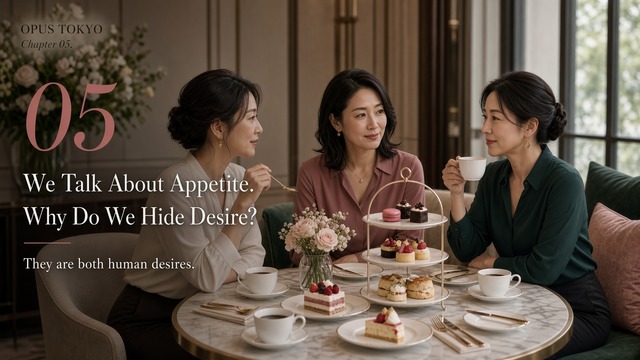
    We Can Talk About Appetite and Sleep. Why Is “I Want to Be Desired” So Hard to Say?
    Women in their 40s talking over tea
    The same human desire—yet harder to say aloud.

    There is something curious about desire.

    A woman can say, “I ate two pieces of cake yesterday,” and friends may laugh. She can say, “I slept twelve hours,” and someone may tease her for oversleeping.

    But say, “Yesterday I really wanted a man to desire me,” and suddenly the atmosphere changes.

    Why?

    The feeling comes from the same human body and mind, yet sexual desire is more easily tied to morality and character. Women in particular may turn phrases against themselves: “I shouldn’t think like this.” “At my age?” “But I’m a wife.” “But I’m a mother.”

    Yet having a desire and deciding what to do with it are different questions.

    Wanting something does not reduce your worth. Perhaps you can begin simply by allowing yourself to say, “There is something I want right now.”

    Sexual concerns can be difficult to raise even in medical settings. If this feels hard to talk about, you are certainly not the only one.


  • [11-Part Series | Chapter 04] Some Nights, Being Touched Is Not Enough — Wanting to Captivate a Man Again

    [11-Part Series | Chapter 04] Some Nights, Being Touched Is Not Enough — Wanting to Captivate a Man Again

    04

    Wanting to Captivate a Man Again

    Some Nights, Being Touched Is Not Enough — Wanting to Captivate a Man Again
    Mature woman facing a man in a hotel room
    Some nights, touch is not the whole story.

    “Sexual desire” is a useful phrase—perhaps too useful.

    You may want to be kissed. Held. To feel a man’s eyes on your body. To hear “You’re beautiful.” To have a drink together at a hotel bar. To let a man lead for the evening.

    And perhaps you want something else: to see a man become absorbed in you again.

    A man who was calm begins to lose his composure. His gaze changes. His breathing changes. The pauses in conversation change. You want to feel, without needing him to say it, “He truly wants me.”

    What you seek may not be physical contact alone. You may want to see a man desire you as a woman. You may want to experience again the sensation of your own appeal drawing him in.

    “I can still move a man this much.” Perhaps you want that feeling back.

    We can call all of this libido. But wanting sex, wanting a man’s warmth, wanting to confirm that you are desired, and wanting to watch his composure waver because of you are not necessarily identical things.

    You do not need to know the answer before you arrive. It may be all of them, one of them, or something that changes with the night.

  • [11-Part Series | Chapter 03] Maybe Desire Did Not Grow — Maybe There Are Fewer Chances to Feel Desired

    [11-Part Series | Chapter 03] Maybe Desire Did Not Grow — Maybe There Are Fewer Chances to Feel Desired

    03

    Fewer Chances to Feel Desired?

    Maybe Desire Did Not Grow — Maybe There Are Fewer Chances to Feel Desired
    Elegant woman in her 40s walking through a hotel lobby
    Perhaps the environment changed, not the desire.

    Think back, for a moment, to your twenties. There were classmates, colleagues, parties, introductions through friends, invitations, crushes, and sometimes someone showing interest in you.

    Not every woman lived the same youth. But encounters with the opposite sex were often woven more naturally into everyday life.

    In your 40s, things may look different. You may be a wife, a mother, an executive, a manager, a professional—someone expected to make decisions for other people every day. That life matters. This is not about wanting to become twenty again.

    But perhaps one thing has become rarer: time in which a man sees you intensely as a woman.

    His gaze changes. His voice changes. The distance closes. A man who seemed composed begins to lose a little of that composure.

    Maybe your desire did not grow. Maybe something that used to be satisfied naturally now has fewer opportunities to be satisfied.

    Perhaps desire did not increase. Perhaps the opportunities to feel desired decreased.

    Seen that way, “Why am I noticing men so much lately?” may begin to look different.

  • [11-Part Series | Chapter 01] Can “I Feel More Desire Than Before” Actually Be Measured? — Sexual Desire in Your 40s

    [11-Part Series | Chapter 01] Can “I Feel More Desire Than Before” Actually Be Measured? — Sexual Desire in Your 40s

    01

    Can Desire Be Measured in Your 40s?

    Can “I Feel More Desire Than Before” Actually Be Measured? — Sexual Desire in Your 40s
    Woman in her 40s reflecting on changes in desire
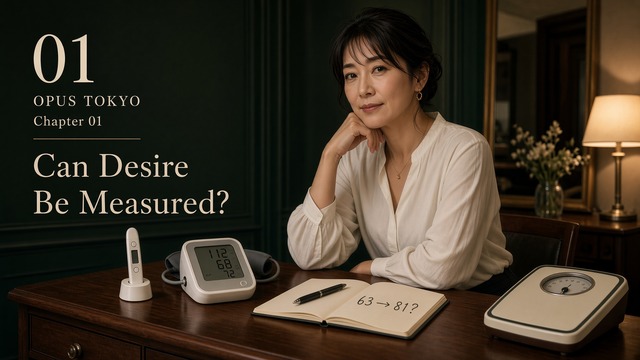
    Desire does not come with a thermometer.

    If your desire had been “63” last year and “81” this year, the answer would be easy: it rose by 18 points. Unfortunately, no such meter exists.

    We can measure temperature, blood pressure and weight. Desire happens inside our own body and mind, yet we cannot see it as a number or compare it accurately with someone else’s.

    So when you feel, “My sexual desire has become stronger in my 40s,” the interesting question is: stronger than what? Your twenties? Your thirties? Your partner? What you hear from friends?

    Perhaps the desire itself has not increased. Perhaps you have simply become more aware of it.

    Female desire is not a single dial controlled only by the body. Health, stress, sleep, work, family, self-image, relationships, safety and intimacy can all matter. Desire may also emerge after closeness begins: after feeling safe, talking gently, noticing distance narrow, or becoming aware of a man’s gaze.

    So if you think, “I’m not even sure what I want,” that is not strange. Human desire was never simple enough to be perfectly translated into words.

  • [11-Part Series | Chapter 02] What Changes in a Woman’s Body in Her 40s? — Menopause, Desire, Body and Mind

    [11-Part Series | Chapter 02] What Changes in a Woman’s Body in Her 40s? — Menopause, Desire, Body and Mind

    02

    Body and Mind Changes in Your 40s

    What Changes in a Woman’s Body in Her 40s? — Menopause, Desire, Body and Mind
    Woman in her 40s looking at herself in a mirror
    Body and mind do not move along a single line.

    In your 40s, the word “menopause” can begin to feel more personal.

    You may wonder, “Do hormonal changes make me want men more?” Or the opposite: “Will those feelings disappear as menopause approaches?”

    It is not that simple. Hormonal changes can alter bodily sensations. Some women experience dryness, discomfort during sex, or changes in sexual response.

    But “being in your 40s means desire becomes stronger” is no more universally true than “menopause means desire must fade.”

    There are individual differences. Yesterday and today can feel different. Some nights you are exhausted by work. Some nights you want to think about nothing. On other nights, your body and mind may suddenly feel unusually free.

    And in your 40s, it is not only the body that has changed. Life itself has changed. At OPUS, we think that may matter just as much.

  • [11-Part Series | INTRO] When You Begin to Notice Men More in Your 40s — What Is Happening in Your Body and Heart?

    [11-Part Series | INTRO] When You Begin to Notice Men More in Your 40s — What Is Happening in Your Body and Heart?

    00

    OPUS JOURNAL

    When You Begin to Notice Men More in Your 40s — What Is Happening in Your Body and Heart?
    Elegant woman in her 40s reflecting on intimacy in a hotel at night
    Something has changed. It does not have to be shameful.

    “Lately, I feel as though I notice men more than I used to.”

    “Am I too old to be thinking about this?”

    “Is there something unusual about me?”

    If a new feeling has appeared inside you and you are not quite sure what to do with it, there is one thing we would like to say first: there is no need to be ashamed of wanting something.

    We feel hungry and want to eat. We feel tired and want to sleep. We may want to be touched. We may want to feel a man’s gaze on our body again. And perhaps we want to see a composed man slowly lose that composure because he is captivated by us.

    Human wants arise without asking permission. Yet while we can casually say, “I want sushi tonight,” or “I barely slept yesterday,” our voices often become quieter when the subject is sexual desire—especially for women.

    Even now, saying “I want a man to desire me,” “I want sex,” or “I want to feel intensely wanted again” can sound like a confession.

    At least during the time you choose an adult service for women, perhaps you do not have to carry that restraint with you. This is a place where wanting someone, wanting to be wanted, and wanting to explore those feelings are already understood.

  • Privacy and Payment|CHAPTER 07 / 08

    Privacy and Payment|CHAPTER 07 / 08

    EXPERIENCE JAPAN WITH SOMEONE|8 CHAPTERS

    CHAPTER 07 / 08

    Privacy, Payment and the Things You Should Not Have to Worry About

    Privacy should stay private.

    07 EXPERIENCE JAPAN WITH SOMEONE|8 CHAPTERS

    Privacy should stay private.

    Payment should be understandable before the day begins.

    A woman should not need to trade unnecessary personal information for reassurance.

    We Do Not Need to Know Everything About You.

    A private service needs enough information to complete a reservation safely and correctly.

    That does not mean every personal fact is relevant.

    Your real name, home address, occupation, public profile or personal history should not automatically become subjects of interest simply because you made a reservation.

    The most secure personal information is often the information a business never collects.

    What Your Companion Learns Personally Should Stay Personal.

    A private conversation may naturally reveal where you live, what you do, what kind of life you have or why you came to Japan.

    Those details may matter to the relationship between you and your Companion in that moment.

    They do not automatically become useful business information for OPUS.

    The distinction matters.

    Private conversation should not become internal entertainment.

    One Reservation. Generally One Payment.

    OPUS is designed so that payment is generally completed when the reservation is confirmed.

    A second payment should not suddenly appear merely because the day has begun.

    The main situations in which another payment may occur are limited: for example, when you choose to extend the time or when you personally request an additional arrangement.

    Even then, the decision should be yours.

    Having a man unexpectedly make you open your handbag and take out your wallet in the middle of a private experience is not the image of gentlemanly service OPUS wants to create.

    The Best Defense Against a Data Leak Is Not Holding Data You Do Not Need.

    Credit-card payments are handled through a payment processor.

    OPUS does not need to build a business around possessing unnecessary card information.

    The same principle applies more broadly.

    Collect less. Share less. Ask only what is relevant.

    Privacy should be designed into the service rather than promised only after information has already been collected.

    Private means private.

    One reservation. Generally one payment. Only the information necessary to provide the service should need to move through the system.

    FROM CHECK-IN TO CHECK-OUT

    Privacy should stay in your hands.

    OPUS aims to reduce unnecessary questions, unnecessary payment uncertainty and unnecessary exposure of personal information.

    ENGLISH RESERVATION
    \n\n
  • You Do Not Have to Wait for the Right Time|CHAPTER 08 / 08

    You Do Not Have to Wait for the Right Time|CHAPTER 08 / 08

    EXPERIENCE JAPAN WITH SOMEONE|8 CHAPTERS

    CHAPTER 08 / 08

    You Can Wait for the Right Person. You Do Not Have to Wait for the Right Time.

    Of course, you could experience Japan this way with a real partner.

    08 EXPERIENCE JAPAN WITH SOMEONE|8 CHAPTERS

    Of course, you could experience Japan this way with a real partner.

    The question is not whether that is possible.

    The question is when.

    Of Course, You Could Do This With a Real Partner.

    A real boyfriend could walk Tokyo with you, change plans with you, explain things, eat with you, take care of you when you are tired and return to the hotel with you.

    There is nothing artificial about wanting that.

    The uncertainty is time.

    No one can tell you when the right person will appear.

    And even when he does, no one can guarantee that this particular trip to Japan will still be waiting.

    You May Want to Experience Japan Now.

    Perhaps your flight is already booked.

    Perhaps you finally have the time.

    Perhaps you spent years prioritizing work, family or other people's needs and this trip belongs to you.

    Waiting for the right person is one decision.

    Waiting to enjoy your own present life is another.

    They do not have to be the same decision.

    You May Visit the Same Japan — and Go Home With a Completely Different Experience.

    The city will be the same.

    Tokyo Tower will still stand in the same place. Sushi will still be served. Trains will still arrive.

    What changes is the relationship inside the experience.

    Someone notices when you are tired. Someone laughs with you when the plan fails. Someone answers the question that occurred only five seconds ago.

    Someone returns to the hotel with you.

    That changes what you take home.

    Not Someone Showing You Japan. Someone Experiencing Japan With You.

    That is the idea behind FROM CHECK-IN TO CHECK-OUT.

    It is not tourism disguised as romance.

    It is a private adult companion experience in which the Japan around you may become part of the relationship.

    You can plan everything or nothing.

    You can talk about history or forget history completely.

    You can stay outside or return to the hotel.

    The center is not Japan alone.

    The center is how you want to feel while you are here.

    You can wait for the right person. You do not have to wait for the right time.

    Japan may be the same place. The experience you carry home does not have to be.

    FROM CHECK-IN TO CHECK-OUT

    Experience the Japan you want now.

    FROM CHECK-IN TO CHECK-OUT brings the city, conversation, companionship and private adult intimacy into one continuous experience.

    ENGLISH RESERVATION
    \n\n
  • I’m a Foreigner. Am I Really Welcome?|CHAPTER 06 / 08

    I’m a Foreigner. Am I Really Welcome?|CHAPTER 06 / 08

    EXPERIENCE JAPAN WITH SOMEONE|8 CHAPTERS

    CHAPTER 06 / 08

    I'm a Foreigner. Am I Really Welcome?

    "I am a foreigner. Am I really welcome?"

    06 EXPERIENCE JAPAN WITH SOMEONE|8 CHAPTERS

    "I am a foreigner. Am I really welcome?"

    It is a reasonable question.

    You should not need to carry that uncertainty into a private experience.

    You Do Not Need to Prove That You Belong Here.

    At OPUS, where you were born, the color of your skin, the language you speak, your religion or the passport you carry does not decide how you are treated.

    You do not need Japanese in order to deserve respectful service.

    Being unfamiliar with Japan is not something to apologize for.

    You are a woman choosing a private adult experience. That is the starting point.

    You Do Not Need Japanese to Choose OPUS.

    You may know no Japanese at all.

    That does not mean you should be placed in situations where you are embarrassed for not understanding a custom that local people consider obvious.

    Necessary rules still matter and will be explained.

    But not knowing something should not become an excuse to blame you, shame you, charge you unexpectedly or treat you as less deserving than a Japanese customer.

    Not Knowing Japan Should Never Become Your Disadvantage.

    A large part of travel stress comes from uncertainty.

    What happens next? Is there another charge? Did I misunderstand something? Was I supposed to know that rule already?

    OPUS tries to move those questions forward in time.

    If something can affect your decision, cost or schedule, the goal is to explain it before you must decide.

    You should not discover the important part only after the consequence has already occurred.

    We Would Rather Protect Your Dignity Than Test Your Knowledge of Japan.

    You did not come to Japan to pass an examination in Japanese culture.

    A private Companion should not stand beside you waiting for you to make a mistake.

    If a cultural difference creates confusion, he can help.

    If you need him to speak first at the hotel, he can take the lead.

    If something unexpected happens, you should not suddenly be left alone to solve Japan by yourself.

    Not knowing Japan should never become your disadvantage.

    You do not need perfect Japanese. You do not need any Japanese at all to deserve clarity, dignity and equal treatment.

    FROM CHECK-IN TO CHECK-OUT

    Yes. As you are.

    OPUS is designed so that unfamiliar language, customs or local knowledge do not have to become additional anxiety.

    ENGLISH RESERVATION
    \n\n
  • Beyond Translation|Understanding Japan|CHAPTER 04 / 08

    Beyond Translation|Understanding Japan|CHAPTER 04 / 08

    EXPERIENCE JAPAN WITH SOMEONE|8 CHAPTERS

    CHAPTER 04 / 08

    Beyond Translation|Understanding the Japan Around You

    Translation tells you what was said.

    04 EXPERIENCE JAPAN WITH SOMEONE|8 CHAPTERS

    Translation tells you what was said.

    Sometimes the more interesting question is why it was said.

    That is where conversation begins.

    Translation Is Useful. Context Changes the Experience.

    Translation technology is extraordinary.

    It can translate a sign, a menu, an announcement or a sentence within seconds.

    But words are only one layer of what you encounter in Japan.

    Why is the announcement necessary? Why is everyone behaving in the same way? Why is this building important to people who live here?

    Those questions require more than replacing Japanese words with English words.

    A Sumo Match Is More Than the Words in the Arena.

    At sumo, you may want to know what the announcement says.

    But you may also wonder why spectators react in a certain way, what the referee is doing, why some wrestlers have different hairstyles, or why particular rituals occur before the bout.

    A literal translation can answer one part.

    A person beside you can connect the words to history, custom and what is happening in front of you.

    And he can explain only as much as you actually want to know.

    Tokyo Tower and Tokyo Skytree Are More Than Directions on a Map.

    A navigation app can tell you how to reach Tokyo Tower or Tokyo Skytree.

    But perhaps you want to know why Tokyo Tower still has emotional meaning to many Japanese people even after a newer tower was built.

    Perhaps you want to know what local people actually think about a landmark that appears in international guidebooks.

    Those are not questions of navigation.

    They are questions about how a place lives inside a culture.

    The Explanation Can Change With the Woman Asking.

    A good explanation is not simply accurate.

    It fits the person listening.

    If you already know Japanese history, you do not need a beginner's explanation.

    If you have just arrived in Japan for the first time, you should not be expected to know what locals take for granted.

    Your Companion can see your face, hear your question and adjust.

    That is something a static guidebook cannot do.

    A translation app can tell you what was said. But what if you want to know why?

    The most interesting questions about Japan often appear only after you arrive.

    FROM CHECK-IN TO CHECK-OUT

    Understand the Japan around you.

    FROM CHECK-IN TO CHECK-OUT can include conversation, translation and cultural context — always according to what you actually want to know.

    ENGLISH RESERVATION
    \n\n
LINEで相談する